
A Simple Step-by-Step Guide to Getting Your Business Finances Organized - Part 1
A Simple Step-by-Step Guide to Getting Your Business Finances Organized - Part 1
By Anna-Kay Wilson
Managing Director of Premium Consultancy Services Limited

Is Your Business Making Money, or Are You Just Making Sales?
You started your business with an idea, a product or a service that you believed people would pay for. You worked hard to attract customers, generate sales and build a name for yourself.
But here is an important question:
Do you actually know how much money your business is making?
You may know how much you sold last week, how much customers owe you, or how much money is currently in your business bank account. But can you confidently say how much your business earned after paying its expenses?
If you cannot, you are not alone.
Many small business owners operate using notebooks, WhatsApp messages, bank statements, spreadsheets or simply their memory. Some only organize their financial information when it is time to file their taxes or when a bank requests financial statements.
Unfortunately, this approach can make it difficult to understand how the business is performing, identify financial problems early and make informed decisions.
The solution does not necessarily require expensive accounting software or complicated accounting knowledge.
It starts with proper bookkeeping and a consistent process for recording your business transactions.
In this guide, Premium Consultancy Services Limited (PCS) walks you through the basics of bookkeeping, using practical examples relevant to Jamaican small businesses. Whether you are a sole trader, self-employed professional, service provider, retailer or small company owner, you can use these steps to start organizing your business finances.
1. Why Does Bookkeeping Matter for Your Small Business?
Bookkeeping is the process of recording, organizing and maintaining your business's financial transactions.
It involves keeping track of the money coming into your business, the money going out, what your business owns and what it owes.
Although bookkeeping is often viewed as something you do for tax purposes, its importance extends far beyond filing your annual tax return.
There are two fundamental reasons every business owner should maintain proper financial records.
A. It helps you understand whether your business is profitable.
Making sales does not automatically mean your business is making a profit.
For example, imagine that a small business generates J$500,000 in sales during a month.
At first glance, that might seem like a successful month. However, after paying for inventory, transportation, rent, utilities, advertising, wages and other operating costs, the business may have very little left.
Consider this simple calculation:
Sales revenue J$500,000
Cost of goods sold (J$200,000)
Operating expenses (J$180,000)
Net profit J$120,000
The business generated J$500,000 in sales, but its profit was J$120,000.
That is a significant difference.
Your bookkeeping records help you understand:
- How much money your business generates.
- Which products or services contribute most to your revenue.
- How much you spend to operate the business.
- Whether your expenses are increasing.
- Whether your prices are sufficient to cover your costs.
- How much profit your business earns.
- Whether your business is financially sustainable.
Without accurate records, you may continue operating a business that generates substantial sales but consistently struggles to make a profit.
B. It helps you prepare for tax time.
Business owners have tax and statutory obligations that require accurate financial information.
In Jamaica, depending on your business structure and registration status, you may have obligations relating to income tax, General Consumption Tax (GCT), payroll taxes and statutory deductions, among others.
Your bookkeeping records provide the supporting information needed to prepare financial statements, calculate taxable income and complete the relevant tax returns.
Proper records also help you substantiate the income and expenses reported to Tax Administration Jamaica (TAJ).
You should not wait until March or April to start searching through bank statements, invoices and receipts.
When your bookkeeping is maintained throughout the year, tax preparation becomes more organized and you are better positioned to meet your obligations.
Remember: Bookkeeping is not simply about satisfying the tax authorities. It is about understanding and managing your business throughout the year.

2. Your Step-by-Step Guide to Small Business Bookkeeping
You do not need to become an accountant to understand the basics of bookkeeping.
What you need is a consistent process.
Here are eight practical steps to help you get started.
STEP 1: Separate Your Business and Personal Finances
One of the most common bookkeeping challenges among small business owners is mixing personal and business transactions.
For example:
- A customer pays for a product, and the money goes into your personal bank account.
- You purchase business supplies using your personal debit card.
- You use your business account to pay your personal grocery bill.
- You transfer money between personal and business accounts without recording the reason.
These transactions make bookkeeping unnecessarily complicated.
When personal and business transactions are mixed, you must spend additional time identifying which transactions relate to the business and which are personal.
What should you do?
- Open a separate bank account for your business activities, where appropriate.
- Use a dedicated debit or credit card for business purchases.
- Direct customer payments into your designated business account.
- Pay business expenses from your business account.
- Record any money you contribute to or withdraw from the business.
For Jamaican sole traders, separating finances is particularly important because the owner and the business are not separate legal persons in the same way that a limited liability company is.
For registered companies, maintaining a clear distinction between company funds and personal funds is even more important. Company money should not be treated as the director's personal money.
PCS Tip: If you occasionally use personal funds to purchase something for your business, keep the receipt and record the transaction appropriately. The same applies when you use business funds for a personal transaction.
The objective is to ensure that every transaction has a clear business purpose and is properly classified.
STEP 2: Collect Your Financial Records Every Month
Your bookkeeping should be done consistently, preferably every month.
Do not wait until the end of the financial year to organize twelve months of transactions.
At the beginning of each month, gather the records relating to the previous month.
These include:
Income records
- Sales invoices
- Receipts issued to customers
- Cash sales records
- Point-of-sale reports
- Online payment confirmations
- Bank deposit records
- Records of outstanding customer payments
Expense records
- Supplier invoices
- Purchase receipts
- Utility bills
- Rent receipts
- Transportation expenses
- Payroll records
- Software subscriptions
- Bank charges
- Other business-related payments
Banking records
- Business bank statements
- Credit card statements
- Loan statements
- Payment processor statements
- Records of transfers between accounts
If your business accepts cash, you should also maintain a daily cash record showing the amount received, the purpose of the payment and how the money was used or deposited.
A bank statement alone is not sufficient to explain every business transaction. For example, a bank transaction showing J$15,000 may tell you how much was paid, but it does not necessarily explain what was purchased or whether the expense was business-related.
Keep the supporting documentation.
PCS Tip: Set aside a specific day each month to organize your financial documents. You can use Google Drive, OneDrive or another secure document storage system to organize invoices, receipts and statements electronically.
STEP 3: Categorise Your Business Income
Once you have collected your financial records, the next step is to organize your income.
Instead of recording everything under one general heading called "Sales", identify the different ways your business earns money.
For example, a Jamaican retail business may generate income from:
- Clothing sales
- Accessories
- Footwear
- Delivery charges
A service-based business may earn income from:
- Consulting services
- Professional fees
- Bookkeeping services
- Training and workshops
- Project-based engagements
A food business may earn income from:
- Food sales
- Beverage sales
- Ice cream and desserts
- Catering services
Separating your income into meaningful categories helps you identify which areas of the business generate the most revenue.
For example, if your business offers three services, you may discover that one service generates 60% of your revenue while another contributes only 10%.
This information can help you determine where to focus your marketing, resources and business development efforts.
Important: If your business is registered for GCT, ensure that GCT collected from customers is properly accounted for. GCT collected is generally a tax liability and should not be treated as your business's earned revenue.
Your sales records should distinguish the value of the sale from the applicable GCT.
STEP 4: Categorise Your Business Expenses
Knowing how much money your business spends is just as important as knowing how much it earns.
You do not need dozens of expense categories to get started. Most small businesses can begin with a manageable list and expand it as necessary.
Here are some common expense categories relevant to Jamaican businesses:
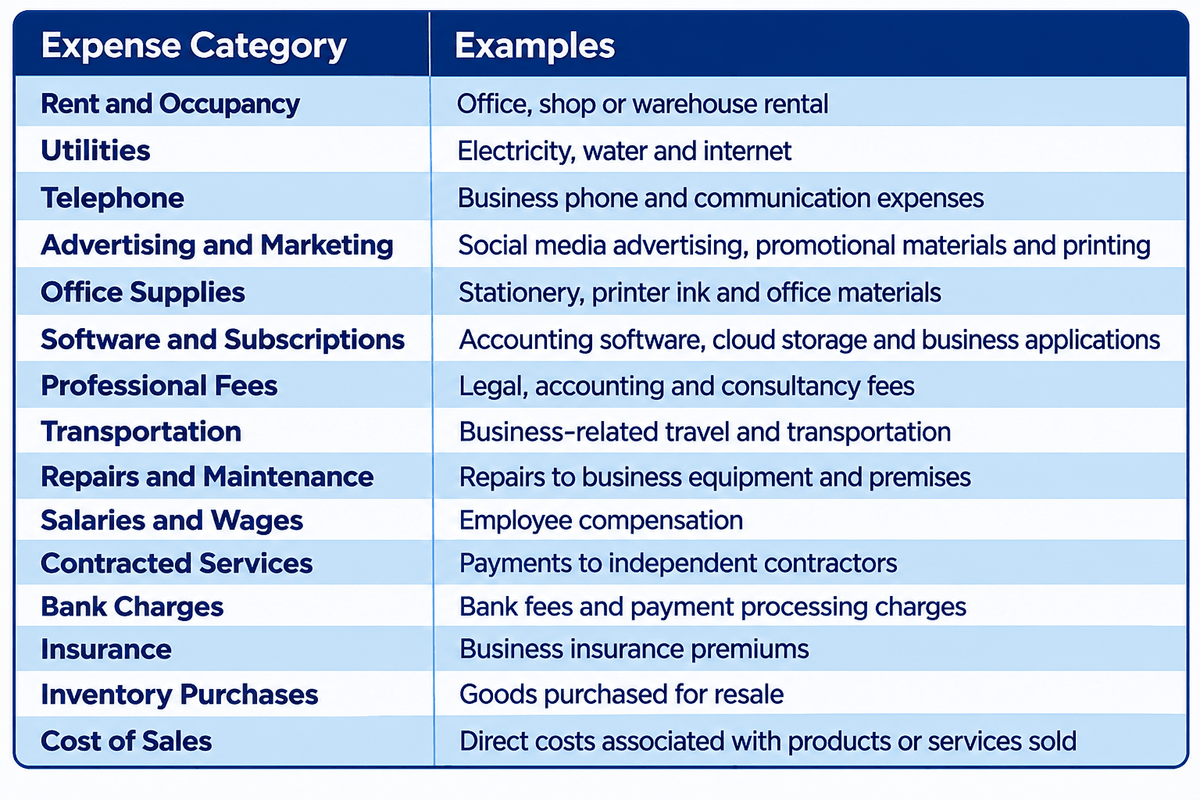
Your business may require additional categories depending on its operations.
For example, a construction business will have different cost categories from a retail store or a professional services firm.
Do not classify every payment from your bank account as an expense.
Some transactions require special accounting treatment.
Examples include:
- Purchasing equipment that may need to be recorded as an asset.
- Repaying the principal portion of a business loan.
- Transferring money between bank accounts.
- Purchasing inventory that has not yet been sold.
- Paying personal expenses from business funds.
These transactions should be properly classified rather than automatically recorded as operating expenses.
STEP 5: Understand What Is NOT Business Income or an Expense
This is where many business owners make bookkeeping mistakes.
Money entering or leaving your bank account does not automatically represent income or an expense.
Understanding the difference is essential.
1. Money you contribute to your business
Suppose you transfer J$100,000 from your personal savings into your business bank account to purchase inventory.
That J$100,000 is not sales revenue.
It is an owner's contribution or capital introduced, depending on the business structure and nature of the transaction.
2. Money you transfer between business bank accounts
Suppose you transfer J$50,000 from your business savings account to your business current account.
This is not new income or an expense.
It is simply a transfer between accounts belonging to the same business.
3. Personal expenses paid using business funds
Suppose you use your business debit card to purchase personal groceries for J$12,000.
That J$12,000 should not be recorded as a business expense.
For a sole trader, it would generally be treated as an owner's drawing.
For a company, the appropriate classification may be a director's loan, an amount recoverable from the director, remuneration or another relevant account, depending on the circumstances.
4. Repayment of business loans
Suppose your business makes a monthly loan payment of J$40,000.
The entire J$40,000 is not necessarily an expense.
A loan repayment generally consists of:
- Principal: Reduces the outstanding loan balance.
- Interest: Represents the cost of borrowing and is generally recorded as a finance expense, subject to applicable tax rules.
Only the interest portion is normally charged to the Profit and Loss Account. The principal portion reduces the liability recorded on the Balance Sheet.
5. Purchasing equipment
If you purchase a computer, vehicle or other significant business equipment, the purchase may need to be recorded as an asset rather than charged entirely as an expense in the month of purchase.
The appropriate accounting treatment will depend on the nature of the item and the applicable accounting and tax rules.
Understanding these distinctions will help you avoid overstating your income or expenses and producing inaccurate financial reports.
STEP 6: Calculate Your Business Profit
Now that you have organized your income and expenses, you can calculate your profit.
The basic formula is:
Net Profit = Total Revenue - Total Expenses
Let's use another Jamaican business example.
A small service business records the following transactions for October:

Based on these figures, the business generated J$600,000 in revenue and earned J$300,000 in profit.
That means the business retained J$300,000 after the expenses listed above.
However, remember that profit and cash flow are not the same thing.
Your business may report a profit but still struggle to pay its bills because customers have not paid their invoices, inventory has been purchased, loan principal has been repaid or other cash payments have been made.
That is why you should monitor both profitability and cash flow.
STEP 7: Calculate Your Profit Margin
Knowing your profit is important, but understanding your profit margin provides another useful perspective.
Your profit margin shows how much profit your business earns for every dollar of revenue.
The formula is:
Net Profit Margin = (Net Profit ÷ Revenue) × 100
Using the previous example:
Net Profit = J$300,000
Revenue = J$600,000
Profit Margin = (300,000 ÷ 600,000) × 100
Profit Margin = 50%
This means that for every J$100 generated in revenue, the business earned J$50 in net profit.
Here are some other examples:
- 5% profit margins means J$5 profit for every J$100 in revenue
- 10% profit margins means J$10 profit for every J$100 in revenue
- 20% profit margins means J$20 profit for every J$100 in revenue
- 40% profit margins means J$40 profit for every J$100 in revenue
- 50% profit margins means J$50 profit for every J$100 in revenue
Is a 5% profit margin bad? Is a 50% profit margin good?
Not necessarily.
Profit margins vary significantly across industries and business models. A retail business may operate with a lower net profit margin than a professional services business.
The important thing is to understand your own business's profitability, monitor changes over time and compare your performance with relevant industry benchmarks where reliable information is available.
If your profit margin is declining, investigate why.
Are your suppliers increasing their prices? Are you spending too much on advertising? Are you charging customers too little? Are you experiencing unnecessary operating expenses?
Your financial records should help you answer these questions.
STEP 8: Review Your Financial Records Monthly, Quarterly and Annually
Bookkeeping should become a regular business activity, not something you do only when taxes are due.
A simple bookkeeping schedule can help you stay organized.
Monthly
- Record all business income and expenses.
- organize supporting documents.
- Reconcile your bank accounts.
- Review outstanding customer invoices.
- Review unpaid supplier bills.
- Calculate your monthly profit or loss.
- Review your cash position.
Quarterly
- Compare your performance with previous quarters.
- Review revenue and expense trends.
- Assess whether your business is meeting its financial targets.
- Review upcoming tax and statutory obligations.
- Assess whether your prices need adjustment.
Annually
- Complete your year-end bookkeeping.
- Review your financial records for accuracy.
- Prepare your financial statements.
- organize information required for your income tax returns.
- Review your business performance and prepare the next financial year's budget.
When you maintain your books throughout the year, preparing your annual financial information becomes much easier.
With these eight steps, you now have the foundation for organising your business finances and keeping your records up to date. But bookkeeping is only part of the picture. In Part 2, we will explore important Jamaican tax and record-keeping considerations, common bookkeeping mistakes to avoid, and when it may be time to seek professional support.