
"I need an accountant."
This is one of the most common things we hear from new clients, and while it is never the wrong instinct, it often reflects a misunderstanding of what accounting actually is, and more importantly, what most small businesses in Jamaica actually need first.
Bookkeeping and accounting are related, but they are not the same. Knowing the difference helps you make better decisions about your finances, your service providers, and your money. Let us break it down clearly.
The Simple Version
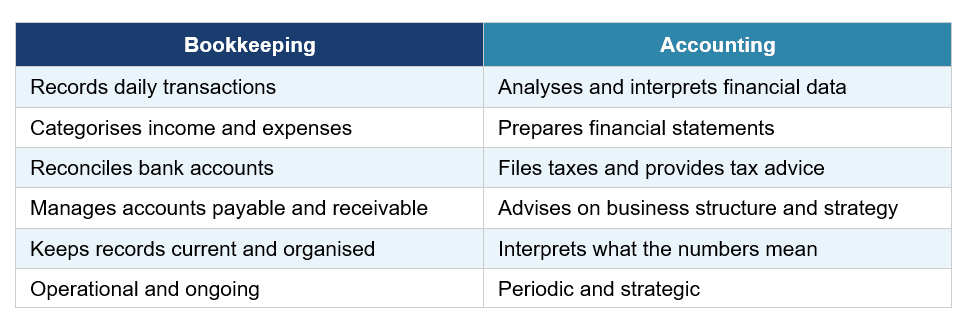
Bookkeeping is the day-to-day recording and organising of financial transactions. Accounting is the analysis, interpretation, and reporting of that financial data.
One comes before the other. You cannot have meaningful accounting without accurate bookkeeping underneath it.
What Does a Bookkeeper Do?
A bookkeeper handles the transactional, operational side of your finances. Their role is to ensure that every financial event in your business is recorded accurately, coded correctly, and kept current.
In practice, a bookkeeper for a small business in Jamaica typically:
- Records all income and expense transactions
- Reconciles bank and credit card accounts monthly
- Manages accounts receivable, tracking who owes you and following up on overdue invoices
- Manages accounts payable, tracking what you owe and when payments are due
- Maintains the Chart of Accounts
- Generates regular financial reports such as the Profit & Loss and Balance Sheet
- Ensures payroll-related entries are recorded correctly
- Keeps records ready for tax filing season
At PCS, this is the core of our bookkeeping service, using QuickBooks Online or Zoho Books, every single month.
What Does an Accountant Do?
An accountant works at a higher level, using the financial records that bookkeeping maintains to produce analysis, provide strategic advice, and handle formal compliance obligations.
An accountant typically:
- Prepares and files income tax returns with Tax Administration Jamaica (TAJ)
- Prepares audited or reviewed financial statements
- Provides advice on business structure, tax strategy, and financial planning
- Interprets financial reports and what they mean for business decisions
- Advises on compliance with the Companies Act, TAJ, and other regulatory bodies
- May provide CFO-level advisory services for growing businesses
At PCS, our Advisory Services and Business Review Sessions (The P.C.S. Way™) bridge the gap between bookkeeping and strategic financial guidance, giving small business owners access to financial intelligence, not just record-keeping.
Which One Does Your Business Need?
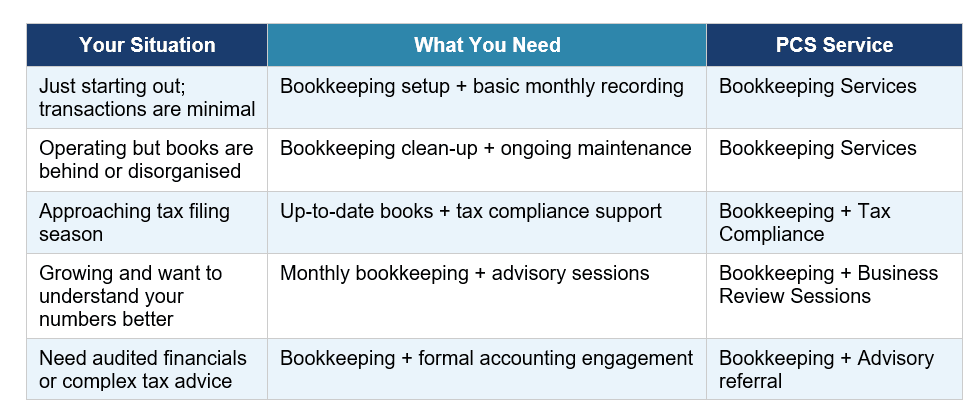
The short answer: most small businesses in Jamaica need bookkeeping first, and accounting on top of it.
Here is a practical guide based on your situation:
Why This Distinction Matters in Jamaica
In the Jamaican business context, this distinction has real consequences.
Tax Compliance
Tax Administration Jamaica (TAJ) requires businesses to maintain proper records. When your books are current and accurately maintained throughout the year, GCT filing, income tax preparation, and payroll compliance are far less stressful and far less likely to result in errors or penalties.
Access to Funding
Whether you are applying for a JN Bank business loan, a JAMPRO grant, or funding from the Development Bank of Jamaica (DBJ), you will need financial statements. Those statements must be built on reliable bookkeeping. Lenders can tell the difference.
Business Decision-Making
Many Jamaican entrepreneurs make decisions based on their bank balance rather than their actual financial position. Proper bookkeeping, producing monthly Profit & Loss and Balance Sheet reports, gives you the real numbers. That is the difference between reactive management and proactive leadership.
The Bottom Line
Bookkeeping and accounting serve different but complementary purposes. Bookkeeping keeps your financial records accurate and current. Accounting uses those records to guide strategic decisions, ensure compliance, and tell you where your business is headed.
If your books are not in order, no accountant, no matter how skilled, can give you the financial clarity your business needs. Getting the foundation right is always the first step.
At Premium Consultancy Services Limited, bookkeeping is our core service and we build everything else from there.
Ready to get your books in order? Book a free 20 minutes introductory call and let us show you exactly how we can help.